What Type of Art Has Been Composed or Constructed in an Algorithmic Manner?
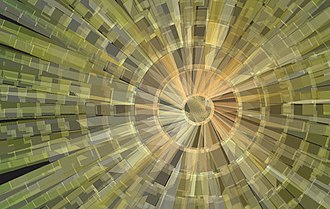
"Octopod" by Mikael Hvidtfeldt Christensen. An case of algorithmic fine art produced with the software Structure Synth.[i]
Algorithmic art or algorithm art is art, mostly visual fine art, in which the design is generated by an algorithm. Algorithmic artists are sometimes called algorists.
Overview [edit]
Algorithmic art, also known as computer-generated art, is a subset of generative fine art (generated past an democratic arrangement) and is related to systems art (influenced by systems theory). Fractal art is an example of algorithmic art.[two]
For an prototype of reasonable size, fifty-fifty the simplest algorithms crave too much calculation for manual execution to exist practical, and they are thus executed on either a single calculator or on a cluster of computers. The terminal output is typically displayed on a computer monitor, printed with a raster-type printer, or drawn using a plotter. Variability can exist introduced by using pseudo-random numbers. There is no consensus every bit to whether the product of an algorithm that operates on an existing paradigm (or on any input other than pseudo-random numbers) can still be considered computer-generated art, every bit opposed to computer-assisted art.[2]
History [edit]
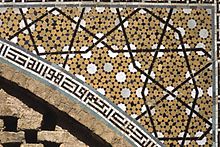
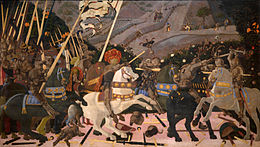
Roman Verostko argues that Islamic geometric patterns are synthetic using algorithms, every bit are Italian Renaissance paintings which make employ of mathematical techniques, in particular linear perspective and proportion.[three]
Some of the earliest known examples of reckoner-generated algorithmic fine art were created past Georg Nees, Frieder Nake, A. Michael Noll, Manfred Mohr and Vera Molnár in the early on 1960s. These artworks were executed by a plotter controlled by a calculator, and were therefore computer-generated fine art but non digital art. The act of cosmos lay in writing the program, which specified the sequence of actions to be performed by the plotter. Sonia Landy Sheridan established Generative Systems every bit a program at the School of the Art Establish of Chicago in 1970 in response to social alter brought well-nigh in part by the computer-robot communications revolution.[4] Her early on work with copier and telematic art focused on the differences betwixt the homo hand and the algorithm.[5]
Bated from the ongoing piece of work of Roman Verostko and his fellow algorists, the side by side known examples are fractal artworks created in the mid to late 1980s. These are of import here because they employ a dissimilar means of execution. Whereas the earliest algorithmic art was "drawn" past a plotter, fractal fine art only creates an epitome in computer memory; it is therefore digital art. The native class of a fractal artwork is an epitome stored on a computer –this is also true of very nearly all equation fine art and of nearly contempo algorithmic fine art in full general. However, in a stricter sense "fractal fine art" is not considered algorithmic art, because the algorithm is not devised by the artist.[2]
In light of such ongoing developments, pioneer algorithmic artist Ernest Edmonds has documented the continuing prophetic role of art in homo affairs by tracing the early 1960s clan between art and the computer upward to a present fourth dimension in which the algorithm is at present widely recognized as a key concept for society as a whole.[half-dozen]
Function of the algorithm [edit]

Letter Field past Judson Rosebush, 1978. Calcomp plotter estimator output with liquid inks on rag newspaper, 15.25 10 21 inches. This image was created using an early on version of what became Digital Effects' Vision software, in APL and Fortran on an IBM 370/158. A database of the Souvenir font; random number generation, a statistical ground to make up one's mind letter size, colour, and position; and a hidden line algorithm combine to produce this scan line raster image, output to a plotter.
From ane point of view, for a work of fine art to be considered algorithmic art, its creation must include a process based on an algorithm devised by the artist. Here, an algorithm is only a detailed recipe for the design and perhaps execution of an artwork, which may include computer code, functions, expressions, or other input which ultimately determines the form the art volition have.[3] This input may be mathematical, computational, or generative in nature. Inasmuch every bit algorithms tend to be deterministic, meaning that their repeated execution would always issue in the production of identical artworks, some external factor is usually introduced. This can either exist a random number generator of some sort, or an external body of data (which can range from recorded heartbeats to frames of a movie.) Some artists also work with organically based gestural input which is then modified past an algorithm. By this definition, fractals made by a fractal plan are not art, as humans are non involved. Notwithstanding, defined differently, algorithmic fine art tin can exist seen to include fractal art, also every bit other varieties such as those using genetic algorithms. The creative person Kerry Mitchell stated in his 1999 Fractal Art Manifesto:[7] [ii] [8]
Fractal Art is non..Computer(ized) Art, in the sense that the computer does all the piece of work. The work is executed on a figurer, but merely at the direction of the creative person. Turn a computer on and get out it solitary for an hour. When you come back, no art volition have been generated.[7]
Algorists [edit]
"Algorist" is a term used for digital artists who create algorithmic art.[iii]
Algorists formally began correspondence and establishing their identity equally artists following a console titled "Art and Algorithms" at SIGGRAPH in 1995. The co-founders were Jean-Pierre Hébert and Roman Verostko. Hébert is credited with coining the term and its definition, which is in the class of his ain algorithm:[3]
if (creation && object of fine art && algorithm && i'southward own algorithm) { return * an algorist * } else { render * not an algorist * } Types [edit]
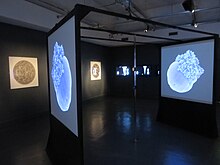
Cellular automata can exist used to generate artistic patterns with an appearance of randomness, or to modify images such as photographs past applying a transformation such as the stepping stone dominion (to give an impressionist mode) repeatedly until the desired artistic effect is accomplished.[nine] Their use has besides been explored in music.[10]
Fractal art consists of varieties of reckoner-generated fractals with colouring chosen to give an attractive result.[11] Especially in the western world, information technology is not fatigued or painted past manus. It is normally created indirectly with the assist of fractal-generating software, iterating through three phases: setting parameters of advisable fractal software; executing the possibly lengthy adding; and evaluating the product. In some cases, other graphics programs are used to further alter the images produced. This is called post-processing. Not-fractal imagery may likewise be integrated into the artwork.[12]
Genetic or evolutionary art makes use of genetic algorithms to develop images iteratively, selecting at each "generation" co-ordinate to a rule defined by the creative person.[13] [14]
Algorithmic art is non simply produced past computers. Wendy Chun explains:[15]
Software is unique in its status equally metaphor for metaphor itself. As A universal imitator/auto, information technology encapsulates a logic of general substitutability ; a logic of ordering and artistic, animating disordering. Joseph Weizenbaum has argued that computers take become metaphors for "effective procedures," that is, for anything that can be solved in a prescribed number of steps, such as gene expression and clerical work.[fifteen]
The American creative person, Jack Ox, has used algorithms to produce paintings that are visualizations of music without using a reckoner. Two examples are visual performances of extant scores, such as Anton Bruckner'south Eighth Symphony[16] [17] and Kurt Schwitters' Ursonate.[18] [19] Later, she and her collaborator, Dave Britton, created the 21st Century Virtual Color Organ that does employ reckoner coding and algorithms.[20]
Since 1996 there have been ambigram generators that car generate ambigrams[21] [22] [23]
See also [edit]
- Algorithmic composition
- Ambigram
- Artificial creativity
- Computer-aided pattern
- Figurer art
- DeepDream
- Demoscene
- Display hack
- Low-complexity art
- Infinite compositions of analytic functions
References [edit]
- ^ Hvidtfeldt Christensen, Mikael. "Hvitfeldts.net". Retrieved ii October 2015.
- ^ a b c d "Approximating Reality with Interactive Algorithmic Fine art". Academy of California Santa Barbara. 7 June 2001. Retrieved 25 December 2015.
- ^ a b c d e Verostko, Roman (1999) [1994]. "Algorithmic Art".
- ^ Sonia Landy Sheridan, "Generative Systems versus Re-create Art: A Clarification of Terms and Ideas", in: Leonardo, Vol. 16, No. 2 (Spring, 1983), pp. 103-108. doi:10.2307/1574794
- ^ Flanagan, Mary. "An Appreciation on the Impact of the work of Sonia Landy Sheridan." The Art of Sonia Landy Sheridan. Hanover, NH: Hood Museum of Art, 2009, pp. 37–42.
- ^ Ernest Edmonds (xv January 2018). "Algorithmic Art Machines". Arts. 7: 3. doi:10.3390/arts7010003.
- ^ a b Mitchell, Kerry (24 July 2009). Selected Works. Lulu.com. pp. 7–8. ISBN978-0-557-08398-5. This artist is notable for his identify in the Fractal Art movement, as is his opinion and manifesto.
- ^ Mitchell, Kerry (1999). "The Fractal Art Manifesto". Fractalus.com. Retrieved 27 December 2015.
- ^ Hoke, Brian P. (21 Baronial 1996). "Cellular Automata and Art". Dartmouth College. Archived from the original on 24 October 2015. Retrieved 24 December 2015.
- ^ Burraston, Dave; Edmonds, Ernest (2005). "Cellular automata in generative electronic music and sonic art: a historical and technical review". Digital Creativity. xvi (iii): 165–185. doi:10.1080/14626260500370882. S2CID 16101588.
- ^ Bovill, Carl (1996). Fractal geometry in architecture and design. Boston: Birkhauser. p. 153. ISBN0-8176-3795-8 . Retrieved 28 October 2011.
- ^ Conner, Elysia (25 February 2009). "Meet Reginald Atkins, mathematical creative person". CasperJournal.com. Archived from the original on twenty Apr 2012. Retrieved 28 October 2011.
- ^ Eberle, Robert. "Evolutionary Art - Genetic Algorithm". Saatchi Art. Archived from the original on 26 December 2015. Retrieved 25 December 2015.
- ^ Reynolds, Craig (27 June 2002). "Evolutionary Computation and its awarding to art and blueprint". Reynolds engineering & Blueprint. Retrieved 25 December 2015.
- ^ a b Chun, Wendy Hui Kyong (2011). Programmed Visions: Software and Memory . MIT Printing. p. two. ISBN978-0262518512.
- ^ Ox, Jack (1990). The Systematic Translation of Anton Bruckner's 8th Symphony into a Series of Thirteen Paintings. Bruckner Symposium 1990. Linz, Republic of austria.
- ^ "Bruckner: Eighth Symphony visualized themes". Intermedia Projects. Retrieved 9 April 2018.
- ^ Ox, Jack (1993). "Creating a Visual Translation of Kurt Schwitters' Ursonate". Leonardo Music Journal. 3: 59–61. doi:10.2307/1513271. JSTOR 1513271. S2CID 61693312.
- ^ Ox, Jack (1993). "Ursonate: Motion I".
- ^ Britton, David; Ox, Jack (2000). "The 21st Century Virtual Reality Colour Organ". IEEE Multimedia. 7: 6–9. doi:10.1109/MMUL.2000.10014.
- ^ "Davalan Ambigram Generator". Davalan.org . Retrieved 1 April 2020.
- ^ "The Make Ambigrams Ambigram Generator". MakeAmbigrams.com . Retrieved i April 2020.
- ^ "Truly Science Free Ambigram Generator". trulyscience . Retrieved 2 April 2020.
Further reading [edit]
- Oliver Grau (2003). Virtual Art: From Illusion to Immersion (MIT Press/Leonardo Book Serial). Cambridge, Massachusetts: The MIT Press. ISBN 0-262-07241-6.
- Wands, Bruce (2006). Art of the Digital Historic period, London: Thames & Hudson. ISBN 0-500-23817-0.
External links [edit]
- [ane]
- Algorithmic Art: Composing the Score for Visual Fine art - Roman Verostko
- Compart - Database of Digital and Algorithmic Art
- Fun with Calculator-Generated Art
- Thomas Dreher: Conceptual Art and Software Art: Notations, Algorithms and Codes
- Existent-Fourth dimension Computer Generated Digital Painting
Source: https://en.wikipedia.org/wiki/Algorithmic_art

Publicar un comentario for "What Type of Art Has Been Composed or Constructed in an Algorithmic Manner?"