How to Upload Unity Game to Itchio
Automatically edifice and deploying Unity applications to crawling.io
When doing game jams, you can hands waste a lot of time fixing one bug, manually build for iv or more than platforms, upload each to itch only to detect in that location is another critical bug and you lot have to first all over once more. In this post, I'll explain how to prepare up continuous deployment so all of this will exist done automatically when you push to your git master branch.
At first glance, it seemed like Unity Cloud build would be the obvious solution… However information technology costs $ix a month, and I but do this equally a hobby and I don't like depending paid services if I don't take to. Also I oasis't checked if information technology would integrate well with Itch.
I decided to go for a docker-based solution, and started looking for images. Later a quick search it seemed pretty articulate that gitlab.com/gableroux/unity3d was the most well-maintained and pop solution.
At that place seems to be two common ways to set it upwardly, either using gitlab-ci, which is what the official example does, or using Travis and GitHub as explained by Carlos Castro on his blog.
I wanted to exercise it the most official way to minimize the amount of corner-cases and workaround I would come across, so I went with gitlab-ci, which means you lot should host your repo on gitlab.com or another GitLab instance.
While the official documentation for setting upward was good plenty, I found it a bit scattered (i.east. some steps are in the output log of a docker container etc. and some info was in the instance readme and some in gitlab issues and some in the gitlab docker epitome readme. Besides I was unfamiliar with GitLab CI, which meant I had to look up a lot of things along the mode.
This is why I decided to write this guide, and then y'all (and time to come me) don't have to search all over the place, when all you want to do is apace automate deployment for a new jam game.
Without farther ado, here are the steps:
Building and testing with GitLab
Add configuration files to your repo
- Clone
https://gitlab.com/gableroux/unity3d-gitlab-ci-instance.gitand re-create these files over to your project- The entire
./cifolder -
.gitlab-ci.yml -
Assets/Scripts/Editor/BuildCommand.cs(needs to be at this particular path in your repo also)
- The entire
- Open up
.gitlab-ci.ymland brand the modifications you need. Yous might want to:- Change
BUILD_NAMEto something sensible. - Edit the
image:field at the summit to fix the unity version you want. I left it atparadigm: gableroux/unity3d:2019.3.7f1every bit that was the version I was on. - Disable the targets you lot don't need, either by deleting or commenting them out, or you can add together a new belongings
when: manualand so they don't trigger automatically. I disabledpages(deploy WebGL build as GitLab page),build-ios-xcode,build-and-deploy-ios,build-android,deploy-android,build-StandaloneLinux64-il2cpp,build-StandaloneOSXUniversal. This left me with just tests, Windows, MacOS, Linux and WebGL beingness built automatically.
- Change
- Commit your changes and push to your GitLab repo.
Now you should be able to go to your project's pipeline overview to view your new gitlab-ci jobs that are existence run. Find information technology past going to CI/CD->Pipelines. You should meet a line there for you newly pushed commit.
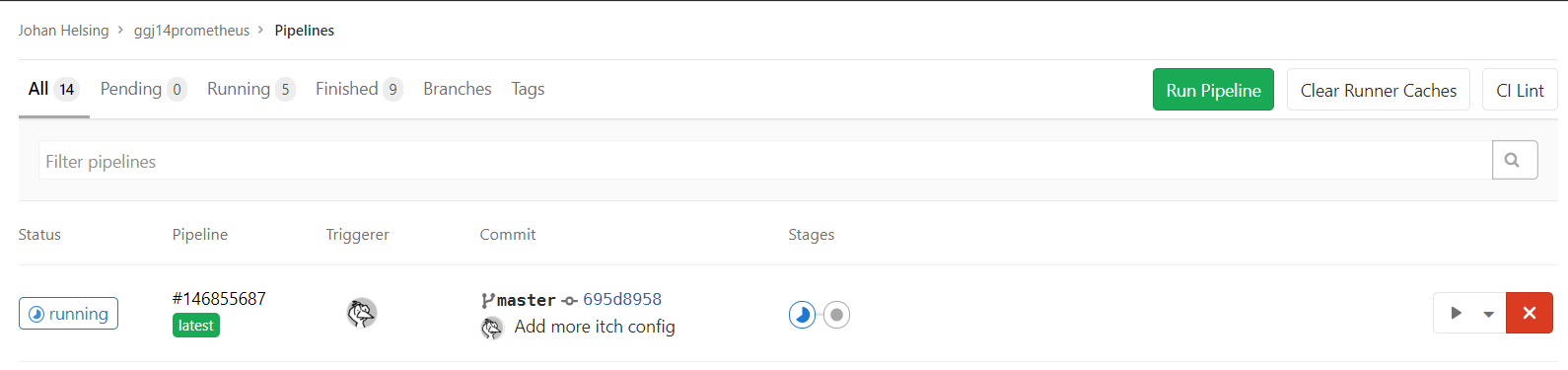
Click where it says running to run into the details of the individual jobs.
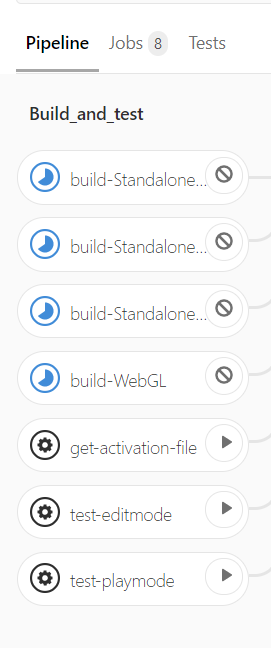
You lot should now see a graph of all your configured jobs. They should all fail considering nosotros haven't withal configured the unity license. This is what we're going to do side by side. :)
Unity activation
Unity activation is a chip of a hassle, and information technology's different depending on whether you're running the pro or gratuitous edition. Here I'll assume you're a hobbyist/indie and is using the free version.
Commencement yous need to go the the license activation file: unity-*.ulf
-
Become to your GitLab project'due south home page and then
Settings->CI / CD->Variables) and add the following variables:-
UNITY_USERNAMEwith contents set to your email -
UNITY_PASSWORDwith your password Marking both as masked and protected.
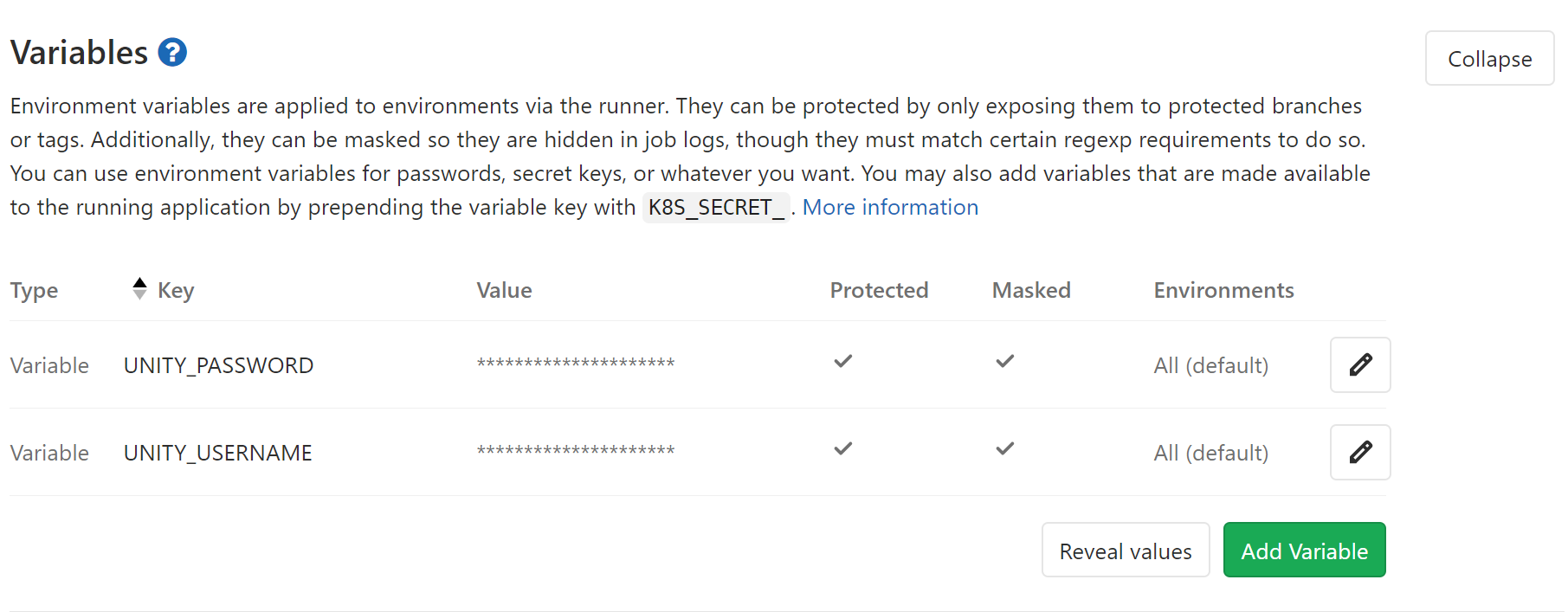
-
-
Go dorsum to the CI pipeline chore overview and run
go-activation-filethe footstep by pressing the play push. -
Download the chore artifact, a zip-file with
unity-*.alfinside 10 minutes (later that it will automatically exist deleted from GitLab) -
Become to https://license.unity3d.com/manual and upload your
Unity-*.alffile.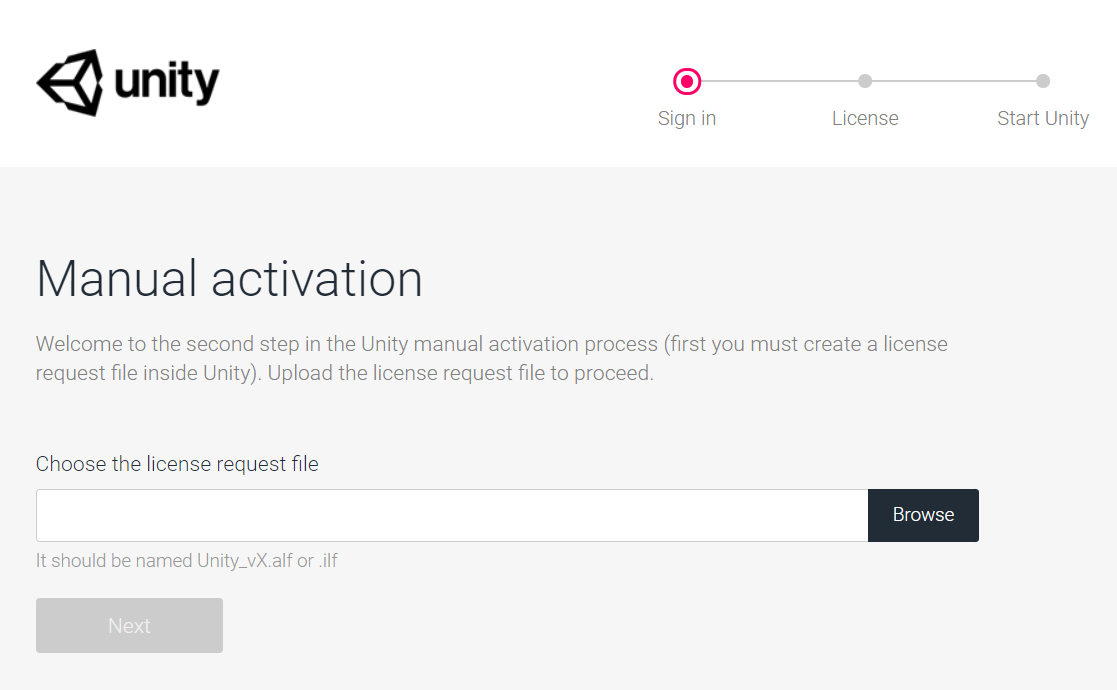
-
Afterward following the steps, you should exist able to download your
unity-*.ulffile. Keep this file, and go on it safe. Yous tin reuse it for other projects with a unity version from the same twelvemonth (and so you don't accept to practise all these steps each time.
Finally, paste the contents of your unity-*.ulf file into a new CI variable (not file), UNITY_LICENSE_CONTENT.
Your project should now exist ready to be congenital and tested. Attempt committing and pushing again, your builds should pass at present. You can download the artifacts from the job details and verify that everything worked.
Deploying to itch.io
Go Butler credentials
- Download butler
- Run
butler loginfrom the command line, and authorize information technology in the browser. - Copy the contents of
~/.config/itch/butler_credsto a new GitLab CI variable,BUTLER_API_KEY, mask and protect information technology.
Add an Itch deployment job
In one case once again, open your .gitlab-ci.yml. We're going to add a new job for deploying to itch.io.
At the starting time of the file, in the variables section, add together the following variables:
variables : BUILD_NAME : ExampleProjectName UNITY_ACTIVATION_FILE : ./unity3d.alf ITCH_USER : your_itch_user ITCH_PROJECT : your_game_name At the end of your file, add the following to create a new deploy task:
itch : image : dosowisko/butler stage : deploy script : - VERSION=$CI_COMMIT_SHORT_SHA - butler push "./Builds/WebGL/${BUILD_NAME}" "${ITCH_USER}/${ITCH_PROJECT}:web" --userversion $VERSION - butler push "./Builds/StandaloneLinux64" "${ITCH_USER}/${ITCH_PROJECT}:linux" --userversion $VERSION - butler button "./Builds/StandaloneWindows64" "${ITCH_USER}/${ITCH_PROJECT}:windows" --userversion $VERSION - butler push "./Builds/StandaloneOSX" "${ITCH_USER}/${ITCH_PROJECT}:mac" --userversion $VERSION only : - chief That's information technology. Commit and push to GitLab, and you should hopefully get a mail from itch.io afterwards a while saying the builds are available :)
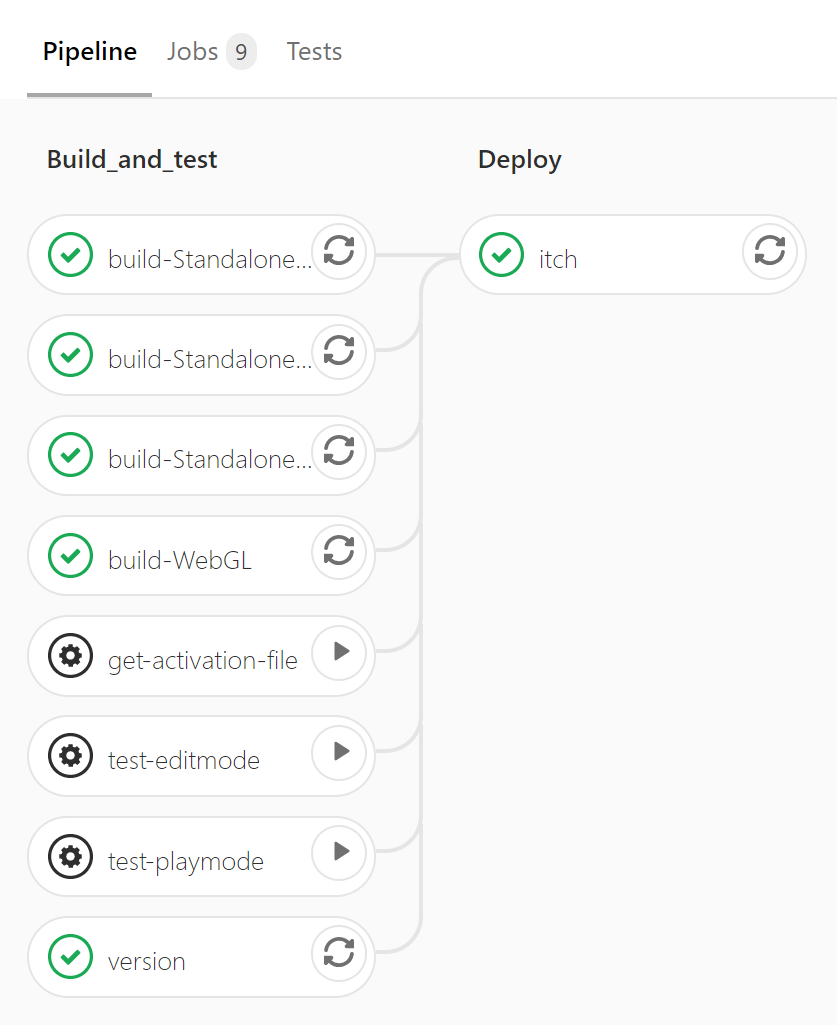
Nicer versions
Equally a bonus: if you lot don't like having only the git sha1 as the version and want to have something based on the latest git tag (you lot need to accept at to the lowest degree one tagged commit), you tin add a new versioning job:
version : epitome : name : alpine/git:latest entrypoint : [ " " ] stage : build_and_test script : - git describe --tag > ./version.txt # will generate something like "1.0.0-32-g040c782" artifacts : paths : - ./version.txt And alter your itch task in .gitlab-ci.yml equally follows to use ./version.txt instead:
itch : image : dosowisko/butler stage : deploy script : - butler push "./Builds/WebGL/${BUILD_NAME}" "${ITCH_USER}/${ITCH_PROJECT}:spider web" --userversion-file ./version.txt - butler button "./Builds/StandaloneLinux64" "${ITCH_USER}/${ITCH_PROJECT}:linux" --userversion-file ./version.txt - butler push button "./Builds/StandaloneWindows64" "${ITCH_USER}/${ITCH_PROJECT}:windows" --userversion-file ./version.txt - butler push "./Builds/StandaloneOSX" "${ITCH_USER}/${ITCH_PROJECT}:mac" --userversion-file ./version.txt but : - master At present you should take nicer versions, just maybe a convoluted in order just to call git describe --tag. If you accept a better proffer, please permit me know in the comments :)
Comments
Source: https://johanhelsing.studio/posts/gitlab-docker-itch-deploy

Publicar un comentario for "How to Upload Unity Game to Itchio"